


You painted a panel in the garage. It looked fine under the lights. You rolled it into the driveway. Suddenly the colour was off. The undertone shifted. The match you were happy with at 9pm was wrong by 9am. That gap is a CRI problem, not a paint problem.
CRI is the spec most Aussies miss when they buy garage and workshop lights. Brightness, watts, even Kelvin all get a column on the box. CRI usually does not. So this guide explains what CRI is, why it matters for the work you actually do under your roof, and what number you should be looking for.
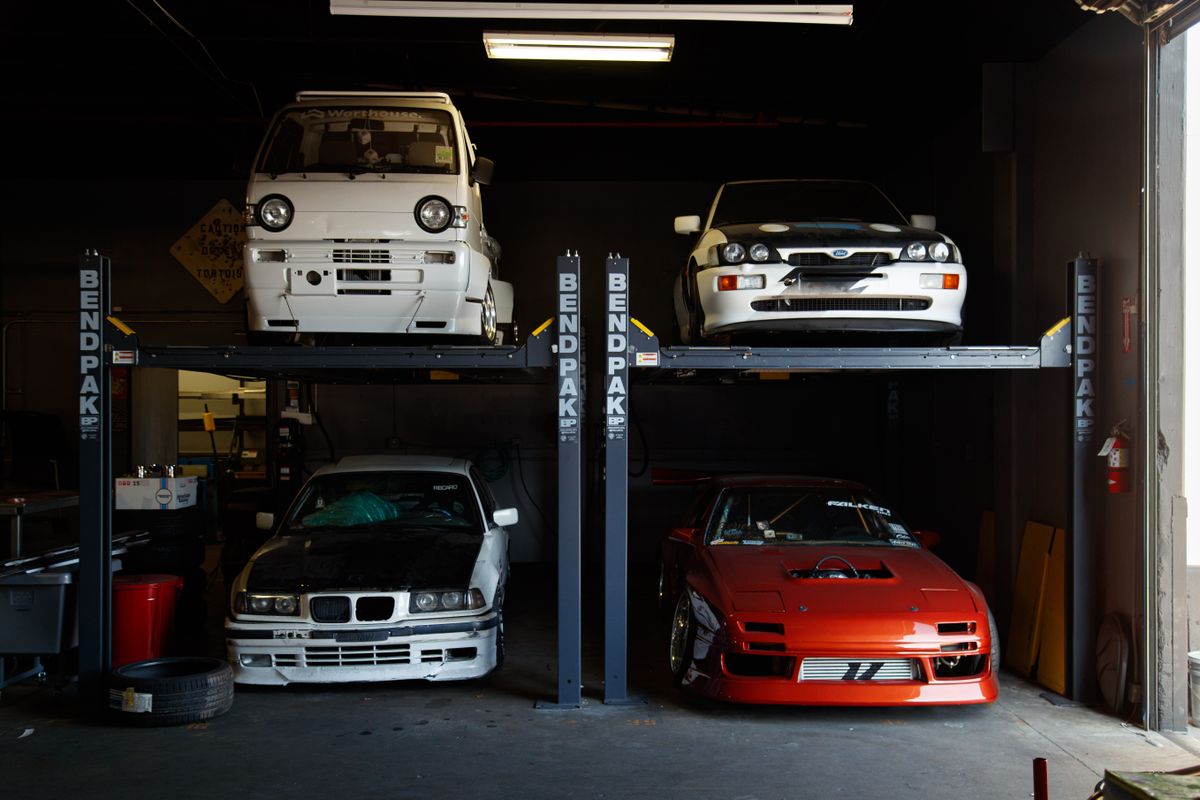
Before: low-CRI fluoros wash colour out of paint and panels.

After: HexSpace hex grid across an Adelaide detailing studio.
The Problem: Why Aussie Garages and Workshops Get CRI Wrong
Most Aussie garage lighting kits are scored on price first and brightness second. CRI rarely makes the marketing copy. Two things make this especially noticeable in the typical Aussie shed or garage.
First, our sheds and garages are typically Colorbond or unpainted timber, with wall reflectance around 20 to 30 percent versus 50 to 70 percent for a painted interior. So a low-CRI lamp loses even more colour information by the time it bounces off your walls and lands on the panel you are trying to match.
Second, the work people do in Aussie garages has shifted. It is not just storage and an oil change anymore. People are doing paint correction, ceramic coatings, fine woodworking, panel beating, custom builds, vinyl wraps, and barbering out of converted home shops. All of that work depends on seeing colour the way it actually is under the sun. A low-CRI kit hides those faults until the job is finished and the customer sees it in daylight.
The Pain Points We Hear Every Week From Detail and Workshop Owners
When customers ring HexSpace asking about hexagon kits, the same colour-related complaints come up over and over. Almost all of them trace back to a CRI problem in the previous setup.
- "Paint looked perfect indoors and wrong on the kerb." Classic CRI 70 to 80 fluoro tube symptom. The light flatters reds and browns, then daylight shows the truth.
- "My customer rejected a vinyl wrap because the colour was off, but it matched in our shop." Same story. The wrap matched the photo under shop lights and shifted under the sun.
- "I cannot tell black from dark navy on a panel under my batten lights." Low-CRI light cannot resolve dark blue and black, especially with a yellow tint.
- "Stain looks even on the bench and blotchy in the photo." The phone camera sees more accurately than a CRI 75 LED. The stain was always blotchy. The light was hiding it.
- "My before-and-after photos look terrible." Cameras white-balance against the light source, so low-CRI light photographs as a sickly green or yellow even when your eye has adapted.
- "I keep missing dust nibs in the clear coat until the customer points them out." Detail inspection without high CRI and the right Kelvin is guesswork. A nib that catches the eye at 1500 lux under CRI 90 light disappears under 600 lux of CRI 75 light.
Who We Are: HexSpace, Australia's Hexagon Lighting Specialist
HexSpace is an Australian hexagon LED lighting brand. Every kit we ship is SAA and RCM certified for AU and NZ electrical safety, built into aluminium housings for hot uninsulated sheds and garages, and rated at CRI 85+ across the 3000K, 4000K, 5000K, and 6500K SKUs. The 6500K daylight option is the one we recommend for any colour-critical work, and it is also our best-selling kit across Aussie sheds, workshops, detailing studios, gyms, and barbershops.
What We Do: Hexagon LED Kits Sized for Real Aussie Spaces
Most CRI complaints are not solved by adding more bad light. They are solved by replacing the source with a high-CRI fixture and getting the lumen output right for the task. Our hexagon kits come in six standard footprints to cover everything from a tool shed to a full commercial workshop.
| HexSpace kit | Footprint | Best for | CRI-relevant use case |
|---|---|---|---|
| 5-Grid LED System | 2.4m x 1.6m | 6 to 10m² | Bench inspection corner, tool shed, model-making |
| 8-Grid LED System | 2.4m x 2.6m | 10 to 14m² | Hobby workshop, small detailing prep area |
| 11-Grid LED System | 3.3m x 2.4m | 14 to 18m² | Weekend workshop with paint and stain work |
| 14-Grid LED System | 4.0m x 2.4m | 18 to 25m² | Single-bay home detailing or panel touch-up |
| 23-Grid LED System | 4.2m x 3.9m | 25 to 35m² | Double-bay workshop, pro detailing studio |
| 39-Grid LED System | 5.3m x 5.0m | 35m² and up | Commercial body shop, showroom, full barbershop fit-out |
How We Solve Each CRI Problem
The three scenes where CRI complaints show up most: panel-correction bays where paint has to match against a swatch deck, barbershops where hair colour has to read accurately under the chair, and workshops where grain and finish need to be readable from the bench. The sections below cover each one.
The pain points above all map to four levers: CRI rating, colour temperature, lumen output, and beam coverage. Get the four right together and the problem disappears. Here is how we approach each.
1. CRI 85+ on Every SKU
We spec CRI 85+ across every colour temperature we ship. Alongside the headline Ra number, the one to watch is R9, the deep red sample that matters most for panel reds and timber stains. That is the point of difference versus a typical CRI 75 to 80 batten light: the same red panel shows up as the right red, not a duller version of it.
2. 6500K Daylight as the Default for Colour-Critical Work
CRI does not work alone. It pairs with colour temperature. A high-CRI lamp at 3000K still gives a warm tint that biases yellows. For paint, detail, and inspection work, the closest thing to outdoor daylight is 6500K. That is why our 6500K SKU is the one we point detailers, panel beaters, woodworkers, and barbers to first. The 4000K and 5000K options exist for hybrid spaces (shed plus home office, gym plus garage), and the 3000K option is for warmer-feel rooms like display areas. Each colour temperature is a separate fixed-output HexSpace SKU.
3. Lumens High Enough to Hit AS/NZS 1680 Targets at Bench Height
CRI 90 light at 400 lux is still too dark to see a swirl mark. You need both. AS/NZS 1680.2.4 sets target lux at workbench height, and the IES Handbook backs this up. Our recommended lumen targets per square metre push toward the higher end of the standard because Colorbond and timber walls eat 2 to 2.5 times more light than a painted interior.
| Task type | Target lux (AS/NZS 1680) | Design lumens per m² |
|---|---|---|
| Storage only | 80 to 160 lux | 200 lm/m² |
| General DIY | 300 to 500 lux | 400 to 600 lm/m² |
| Workshop and bench | 500 to 1,000 lux | 1,000 to 1,500 lm/m² |
| Detailing, paint, fine inspection | 1,000 to 2,000 lux | 1,500 to 2,000+ lm/m² |
For more on the lumen side of the equation, see our piece on how lumens and CRI work together for garage detail tasks. The detailing world has done plenty of its own homework on this; why detailers need high CRI walks through a real Logan-based studio that cut its rework rate from 14 percent to under 4 percent after upgrading.
4. Even Coverage Through Hexagonal Beam Overlap
A single high-CRI tube still casts shadow lines. Hexagons are designed to overlap and fill, so a 14-grid kit at 3m install height covers a 4.0m by 2.4m bay with very even surface lux, not hot spots and dim corners. Even coverage is part of CRI in practice. If half a panel is in shadow, you cannot read the colour properly even under perfect light.
5. Plug-In or Hardwire on the Same Fixture
Every HexSpace kit supports both plug-in and hardwire installation. Plug-in suits a single GPO shed or rented garage. For permanent hardwire installs we recommend a licensed sparky working to AS/NZS 3000. The 3-pin earthed long lead and aluminium housing is built for hot, uninsulated Aussie spaces where cheap plastic-housing kits fail.
6. What Changes When You Fix the Light
Picture a typical panel and detailing bay running twin T5 fluoros: light pools unevenly over the bonnet and deep reds read duller than they really are. Swapping to a properly sized hexagon grid spreads even, high-CRI light across the whole bay, so paint matching happens under the same quality of light the customer will see the car in. That is the practical difference between working under CRI 75 and working under CRI 85 plus.
Why Choose HexSpace Over the Common Alternatives
Most Aussie garage and workshop owners weighing up CRI are choosing between four real options. Here is how they compare on the things that matter for colour-critical work.
| Option | Typical CRI | Best for | Watch out for |
|---|---|---|---|
| LED batten | 70 to 80 | Storage and general use | Distorts reds and browns; usually no R9 spec; cheap drivers flicker |
| LED panel | 80 to 85 | Office and retail | Soft glare; not built for hot uninsulated sheds; rarely 6500K |
| Marketplace hexagon kit | Unverified, often 75 to 80 | Decorative use only | No SAA or RCM; plastic housing; no Aussie warranty |
| High-CRI garage lighting from HexSpace | 85+ verified | Detail, paint, panel, workshop, barber, gym | Higher upfront cost; fixed lumen output; needs sparky for hardwire |
The trade-off is honest. A HexSpace kit costs more than a generic batten. The colour fidelity, the SAA compliance, the aluminium housing, and the 50,000 plus hour rated life are what justify the gap.
What About the Future of CRI?
CRI itself is being slowly replaced. The IES has pushed forward TM-30, a newer colour-fidelity metric that uses 99 colour samples instead of CRI's 8. Standards Australia and Lighting Council Australia have started referencing TM-30 in technical guidance. For now, CRI 85+ is still the practical spec to ask for. Over the next few years expect to see Rf and Rg (the two TM-30 numbers) on premium fixture spec sheets. We are tracking it, and our 6500K SKUs already perform well on TM-30 measurements when we run them. It is a useful complement, not a replacement, for the simple CRI question on the box.
Frequently Asked Questions
What CRI rating is good for a garage?
For a typical Aussie garage used for storage and general DIY, CRI 80 is the practical minimum. For paint touch-ups, mechanical inspection, or any colour matching work, push for CRI 85 or higher. HexSpace hexagon kits ship at CRI 85+ across every colour temperature, so the same fixture works for both general garage use and detail tasks.
Can you really see the difference between CRI 80 and CRI 90?
Yes, on warm tones like red, orange, brown, and skin. CRI 80 hides slight differences in body panel reds, timber stains, and woodgrain. CRI 90 separates them. For storage or general work it does not matter much. For paint, detailing, barbering, and panel inspection, the gap is obvious within a few minutes of switching.
Does higher CRI mean a brighter light?
No. CRI measures colour accuracy, not brightness. Brightness is measured in lumens or lux. A CRI 95 lamp can put out less total light than a CRI 70 lamp. Match CRI to your task type and lumens to your room size separately.
What CRI do I need for paint or detail work?
Australian and international guidance for colour-critical tasks lands at CRI 90 or higher with a colour temperature near daylight (around 6500K). The IES Lighting Handbook treats CRI 90+ as the threshold for paint matching, fabric grading, and detail inspection. HexSpace 6500K hexagon kits sit in this band.
How is CRI different from colour temperature?
Colour temperature (Kelvin) tells you whether the light looks warm yellow, neutral, or cool blue. CRI tells you how truthfully that light shows real-world colours, regardless of its tint. A 6500K daylight lamp at CRI 70 still distorts panel red. A 6500K lamp at CRI 90 shows it correctly. You want both right.
If your space leans more workshop than garage, a lot of this maps directly across; our companion guide to workshop lighting covers how to plan kit count and ceiling height for woodworking, mechanical, and assembly bays.
Ready to fix the colour problem in your shop?
Browse High-CRI Garage Lighting Installation Guide Get a Custom QuoteLast reviewed: May 2026. This article is written and published by the HexSpace team. We design and manufacture premium hexagon LED lighting systems for the Australian and New Zealand market, built to meet local SAA and RCM compliance standards. Where we recommend HexSpace products, it's because we believe they're the right fit for the problem being discussed. We always aim to provide accurate, helpful information regardless of brand. If you have questions, feel free to contact us.


